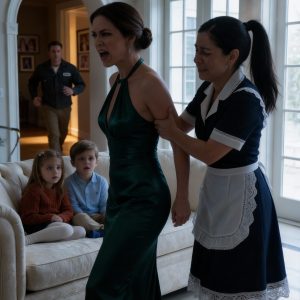
I Found My Daughter Standing Barefoot in the Snow While They Called It “Respect.” Inside, They Were Celebrating Her Silence—So I Took Her Hand, Walked Her Through the Door, and Said the Words That Broke Their Rules.
I arrived earlier than planned—the kind of early that comes from good intentions and no warning at all. I was carrying a pie still warm from the oven, thinking that maybe, just maybe, my daughter had finally settled into the life she kept insisting she was happy with.
That hope vanished the moment I saw her.
She stood at the edge of the front yard, barefoot in the snow, hands clenched together as if holding herself upright was the only rule she knew how to follow.
Snow had been falling for hours—soft enough to look harmless, relentless enough to steal all feeling. She had no coat. No shoes. Her breath came out in shallow clouds, her eyes fixed on the ground, as if she’d learned that looking up only made things worse.
It took my mind a moment to catch up with what I was seeing. No mother expects to find her grown child displayed like a punishment—like a lesson meant to be witnessed, not questioned.
“Anna?”
Her name cracked as it left my mouth.
She flinched—actually flinched—as if my voice had struck her. For a heartbeat, she looked terrified. Not surprised. Not relieved. Afraid. Then recognition softened her face just enough to reveal how completely exhausted she was.
“Mom,” she whispered, lips already pale.
“You weren’t supposed to be here until tomorrow.”
I dropped the pie into the snow without noticing and crossed the yard, shrugging off my coat and wrapping it around her shaking shoulders. Anger bloomed slow and heavy in my chest.
“Why are you outside?” I asked.
“Why don’t you have shoes on?”
She shook her head—a small, automatic motion, the kind people make when they’ve learned explanations only make things worse.
“It’s okay,” she murmured.
“I just needed to cool off.”
The words landed like something practiced.
From inside the house came laughter—glasses clinking, music low and warm, voices overlapping in easy comfort. The contrast between that warmth and the icy cold of my daughter’s skin beneath my hands made something inside me go dangerously still.
“Anna,” I said quietly, “tell me the truth.”
She hesitated, glancing toward the front window where silhouettes moved freely, then spoke.
“I disagreed with Mark in front of his friends,” she said.
“I corrected him about something small.”
She swallowed.
“They said I embarrassed him.”
“So his father said I needed to learn respect.”
The word twisted into something ugly.
“And standing in the snow teaches that?” I asked.
“They said it would remind me of my place,” she replied—no tears now, no shaking. Just a hollow calm that frightened me more than panic ever could.
I took her hand. Her fingers were stiff with cold, her nails bitten down painfully short. I didn’t ask permission before guiding her toward the house.
She resisted, just a little.
“Mom, please,” she whispered.
“It’ll only make things worse.”
I opened the front door with my free hand and stepped inside like the house belonged to us, the cold air following like a witness.
The room went silent.
Mark stood near the fireplace, his drink frozen halfway to his lips. His parents and a few familiar faces stared at us like the evening had gone off script.
Anna stood beside me, barefoot on polished wood, my coat pulled tight around her shoulders.
Mark spoke first.
“What’s going on?” he said, irritation sharp in his voice.
“You’re making a scene.”
I straightened.
“No,” I said calmly.
“I’m ending one.”
His mother frowned, folding her hands together.
She opened her mouth to speak—
“—but let me stop you there,” I said, cutting her off gently, decisively.
“You don’t get to explain this.”
The room held its breath.
“This,” I continued, gesturing to my daughter, “is not discipline. It’s not tradition. And it certainly isn’t respect.”
Mark’s father scoffed. “She needs to learn her place in this family.”
I felt Anna’s hand tighten in mine.
“There it is,” I said quietly. “That word again. Place.”
I turned to Anna. “Sweetheart, you don’t have a place here. You have a life. And no one gets to punish you for using your voice.”
Mark stepped forward. “You’re overreacting. It was just a lesson.”
“A lesson?” I repeated. “You locked a grown woman outside in the snow to entertain yourselves inside.”
I met his mother’s eyes. “If you believe cruelty builds character, then I’m grateful my daughter wasn’t raised by you.”
Anna’s breath hitched.
I turned back to her. “Go upstairs. Pack a bag. Just one.”
Mark laughed nervously. “You can’t be serious.”
“I am,” I said. “And you’re not coming with her.”
Within minutes, Anna returned with a small suitcase. No one moved to stop us. They just watched—stunned, offended, powerless.
At the door, Mark tried one last time. “Anna, don’t do this. You’ll regret it.”
She finally spoke, her voice quiet but steady. “I already regret staying.”
We walked out into the cold together.
That night, she slept on my couch, wrapped in blankets, hands slowly warming, breath evening out. The next morning, she told me things she’d never said out loud—how small she’d learned to make herself, how silence was praised, how obedience was called love.
We filed paperwork the following week. No drama. No explanations owed.
Today, Anna laughs again. She speaks freely. She wears shoes even when she doesn’t need to.
And every winter, when the first snow falls, she sends me a photo of her feet—safe, warm, and planted firmly where they belong.
Not in the cold.
But in her own life.