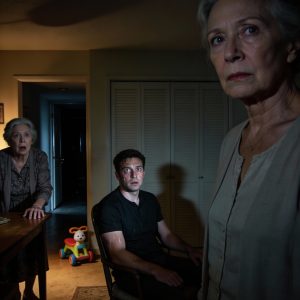
For twenty years, I was the quiet man on the corner who trimmed hedges and kept to himself. The kind of neighbor people barely noticed. But the night I found my daughter shaking on my porch at midnight—bleeding, terrified, thrown out by her husband—something inside me cracked beyond repair. I tucked her into bed, reached for an old piece of my past, and drove into the rain. He opened his door expecting her to beg for forgiveness. Instead, he found a father who had nothing left to fear.
My name is Robert Hale.
To the block, I’m the retired guy at number 17. I water my lawn at dusk. I grow tomatoes that win ribbons at the county fair. I fix loose bike chains for the kids down the street. I nod. I smile. I am safe.
That’s what they believe.
I was in the kitchen steeping tea when I heard it. Not thunder—something smaller. Broken. A sound that didn’t belong to the storm.
A whimper.
I set the kettle down. Quietly. My body shifted from slow to exact. I crossed the room and unlocked the front door without a sound.
Curled on my welcome mat was a woman, soaked through, trembling in a thin satin nightdress. Blood streaked her hair and ran down her temple.
“Please,” she whispered. “Help me.”
I knelt. When she lifted her face into the porch light, my heart stalled.
It was Emma.
My daughter.
Her left eye was swollen shut, skin dark and angry. Her lip was split. Bruises—finger-shaped, unmistakable—ringed her throat.
“Emma,” I breathed, lifting her gently. I reached beneath the sink for my medical kit—not the flimsy kind, but a heavy, well-stocked trauma pack I’d kept out of habit. I cleaned her wounds. My hands, rough from yard work, moved with the calm precision of someone who had done this before—long ago, in places far from home.
“Who?” I asked.
My voice didn’t shake.
Emma opened her good eye. Fear lived there. Pure and raw.
“Caleb,” she whispered. “He came home drunk. He shoved me down the stairs. He laughed.” Her fingers clutched my sleeve. “He said if I told anyone, he’d kill you. Said you were just a harmless old man.”
Something inside me disengaged. Like a switch.
For two decades, I had buried another version of myself under mulch and roses. I had locked him away because the world no longer needed him. But Caleb Mercer—the wealthy developer who married my daughter—had made a terrible mistake. He looked at gray hair and soft manners and saw weakness. He didn’t know he was standing in the shadow of a sleeping mountain.
I settled Emma, waited until her breathing evened, and stood. I walked to the garage.
Under a faded tarp lay an old Louisville Slugger. Ash wood. Balanced. Familiar. I lifted it. Gave it a measured test swing. The air whispered.
In the reflection of the truck window, the eyes staring back weren’t Robert the gardener’s. They were steady. Empty. The eyes of a man who once learned how to walk into danger without blinking.
I drove through the rain to Caleb’s mansion on the hill. Every light blazed.
I climbed the stone steps and struck the oak door—three firm, deliberate knocks.
It opened.
Caleb Mercer stood there with a glass of scotch, shirt unbuttoned, stained dark in places I recognized too well.
He smirked.
“Well, if it isn’t the old man,” he slurred. “Did Emma run crying to Daddy?” He glanced past me into the storm. “Go fetch her. Tell her if she crawls back and apologizes, I might let her in.”
I let the rain soak my hair. I slumped my shoulders, made myself small.
“Caleb,” I said, letting my voice tremble—fear, perfectly performed. “She’s hurt bad. Why… why did you do this?”
And as he leaned closer, convinced he was in control, he never noticed the moment the night decided otherwise.
Caleb laughed.
A loud, careless sound. He took a step closer, close enough that I could smell the whiskey on his breath and see the dull confidence in his eyes.
“Because I can,” he said. “Because she’s mine.”
That was when I straightened.
Just a little.
Enough for him to notice.
The tremor left my voice.
The slump left my shoulders.
“Listen carefully,” I said. “You’re going to sit down. You’re going to put the glass on the table. And you’re going to keep your hands where I can see them.”
He blinked, confused. Then he laughed again.
“You think you scare me? You’re an old man with a—”
I stepped forward.
Not fast. Not angry. Certain.
The bat never left my hand, but I didn’t raise it. I didn’t need to.
Something in my eyes finally reached him. Not rage. Not threat.
Decision.
His smile died.
“You broke my daughter,” I said quietly. “That ends tonight.”
He reached for his phone.
I was faster.
The bat came down—not on him, but on the marble table beside the door. The crack echoed through the house like a gunshot. The table split cleanly in two.
Caleb stumbled back, white now. Sober.
“Sit,” I repeated.
He did.
I took his phone, dialed, and placed it on speaker.
“911,” the operator answered.
“This is Robert Hale,” I said. “I’m at 842 Crestview Drive. There’s a domestic assault victim. Severe injuries. The suspect is present and intoxicated.”
Caleb stared at me in disbelief.
“You… you called the cops?”
“Yes.”
“You’re dead,” he hissed. “When I get out—”
“You won’t,” I replied. “And if you ever come near my family again, prison will be the safest place for you.”
Sirens arrived faster than he expected.
So did consequences.
The police saw the blood on his shirt. The broken table. The recorded voicemail Emma had left me weeks earlier that she’d been too afraid to explain. The hospital photos. The neighbors who’d heard screaming before.
He was taken away in handcuffs.
Emma never went back.
She stayed with me while she healed—physically and slowly, painfully, inside. We pressed charges. We didn’t back down. The wealth, the lawyers, the threats—they didn’t matter.
The truth did.
Months later, the house on the hill went dark. Sold. Empty.
I went back to my roses. My lawn. My quiet waves.
But now, when I smile, it’s different.
Because everyone on that street knows something they didn’t before:
The quiet man at number 17 isn’t harmless.
He’s just peaceful.
And there’s a difference.